













AI has swept the world for the past few years, with its development rapidly increasing in such a short amount of time. Its usage is becoming more and more prevalent in daily life. This poses the question: should AI be used in schools?
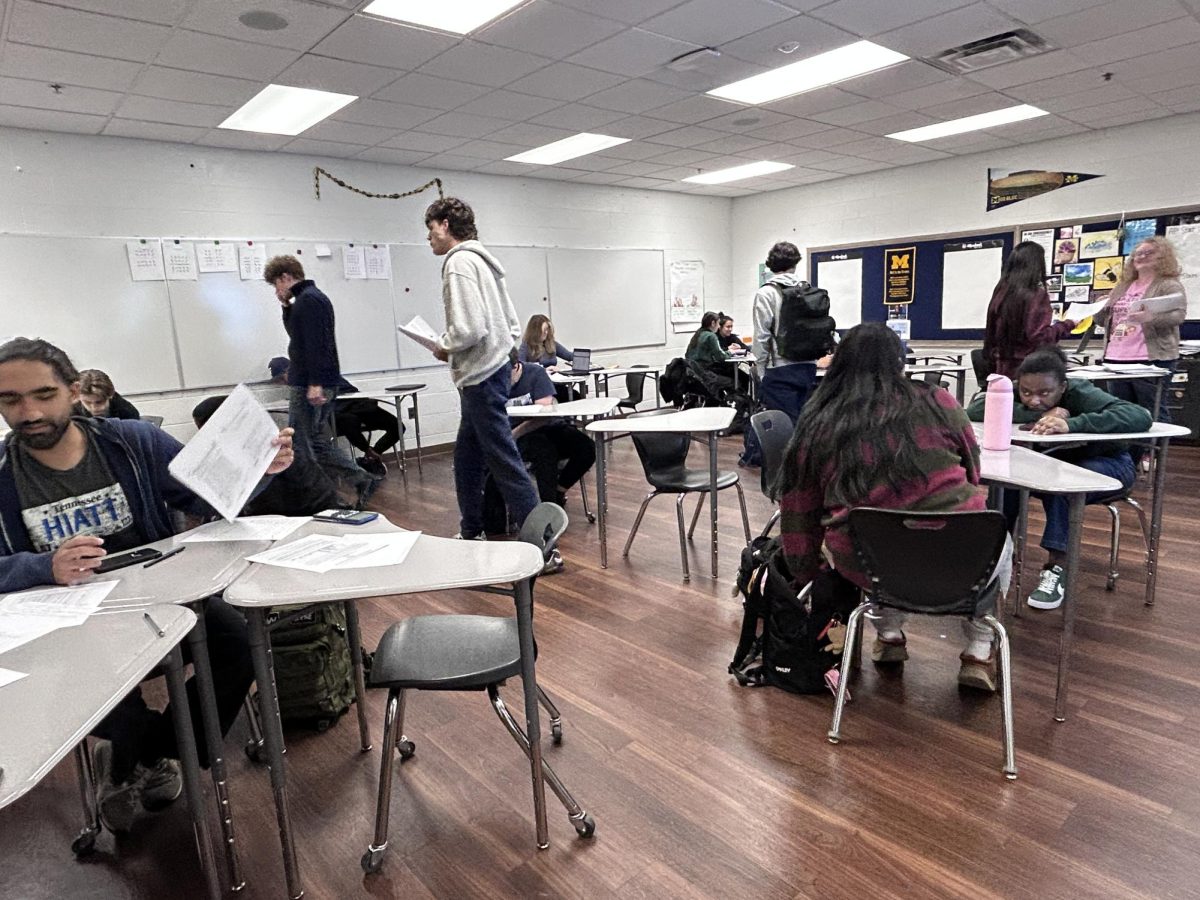
Technology is ever-evolving, and AI’s advancement isn’t slowing down anytime soon. It has already shown up in schools, utilized by all ages. At Farmington High School, teachers and students alike are divided. FHS science teacher Richard Lund aligns with those who feel that AI is a valuable tool.
“Like any tool, it’s neutral,” Lund said. “It’s what you choose to do with it that can be positive or negative. It’s here for good, so we better learn how to use it and how to build a correct society around it.”
Lund believes that AI is good for aiding in problem solving, especially when working with subjects like science.
“Rather than those saying to AI, ‘solve this for me, what’s the answer?’” Lund said. “Instead, I could describe it. I’ve gotten this far, I’ve found this value, don’t tell me the answer, but what’s the part I’m missing.”
Still, Lund believes that AI use in school should not go past being an aid in learning. He urges people to be cautious and “proceed responsibly” rather than using AI for a “blind completion” of work
On the other hand, FHS English teacher Nicholas Gensheimer is fully against AI use in school, even as an aid.
“I’m a big proponent of students using their own creativity and going through the process of learning to develop their own strategies,” Gensheimer said. “I have found that when [AI] is used as a tool, it almost creates a crutch.”
Gensheimer, along with other English teachers, is trying to combat AI use on assignments by going back to paper assignments.
“I’m leaning back into paper copies of rough drafts and final drafts,” Gensheimer said. “That way you can see the students’ actual knowledge.”
Not only is Gensheimer worried about AI reliance in schools, but he feels that AI is becoming bigger than it was meant to be.
“I think that we misuse it trying to make our life easier,” Gensheimer said. “It’s replacing the human side of things. We might have created it initially to do the heavy lifting for research papers, [but] it’s doing other creative things like making art or trying to copy and make new stories, whereas that should be where human creativity comes in.”
Similar to staff, the student body is highly opinionated. Junior Opal Murray is against AI both in schools and in everyday life.
“School was made for expanding your critical thinking skills,” Murray said. “Using AI is completely defeating the purpose of it.”
Murray also wishes AI use was more widely recognized as an issue within the school system with many students turning to ChatGPT for help with assignments during school.
“It’s really unfortunate that the administration isn’t making this a bigger priority,” Murray said. “They’re putting a lot of emphasis on the phone ban, but I feel like they need to be putting more emphasis on AI because if students keep using it, they’re not going to learn anything.”
Conversely, junior Samarth Kaukuntla is in favor of integrating AI into the existing curriculum in schools because students will need AI to succeed in the future.
“I think [in] more analytical or math based subjects, AI is very helpful,” Kaukuntla said. “I think it helps with deep research, deep thinking, [and] it can be helpful to proofread anything you’re doing.”
While Kaukuntla wants to see an increase in the use of AI academically, he does not think it should go too far.
“I believe that AI is a tool that should be used in assistance to existing standards,” Kaukuntla said. “I don’t think it can necessarily replace much.”
AI usage is a divisive subject in general, not just in schools. Since modern AI is still in its relative infancy, the debate on the ethics of Artificial Intelligence and its role in the academic world will likely continue to evolve.