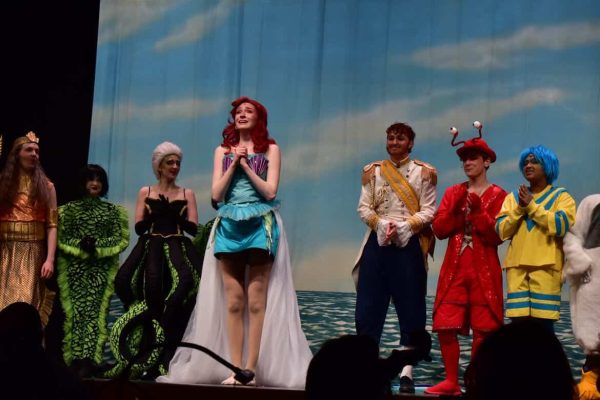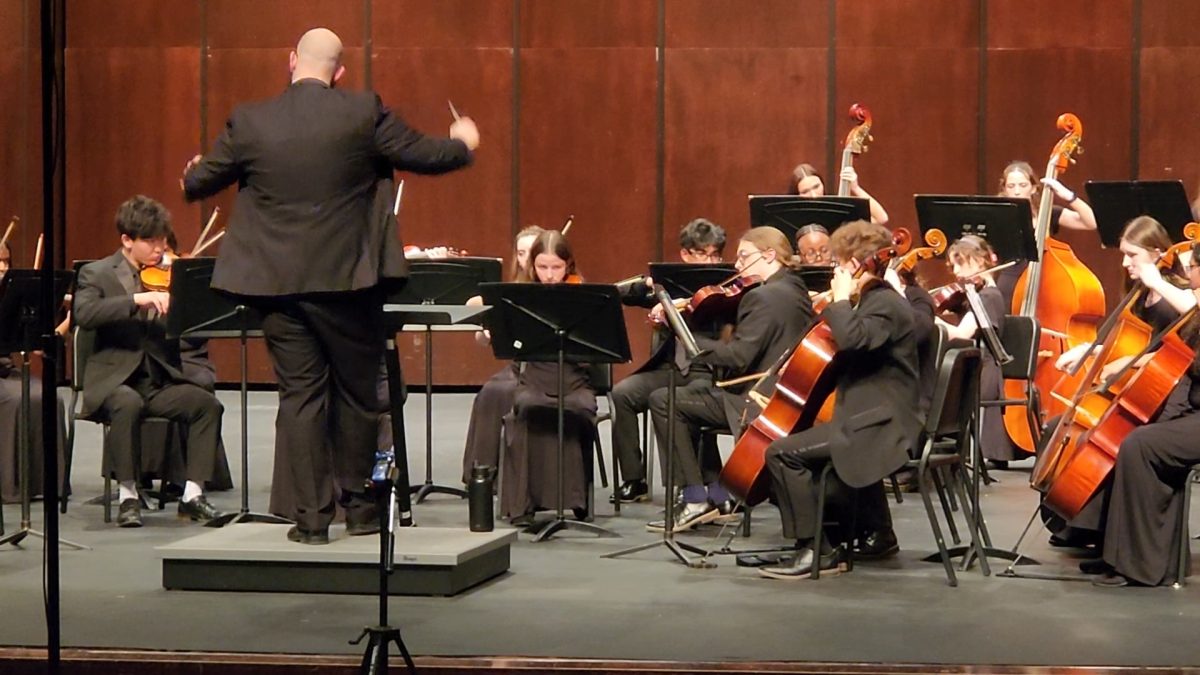










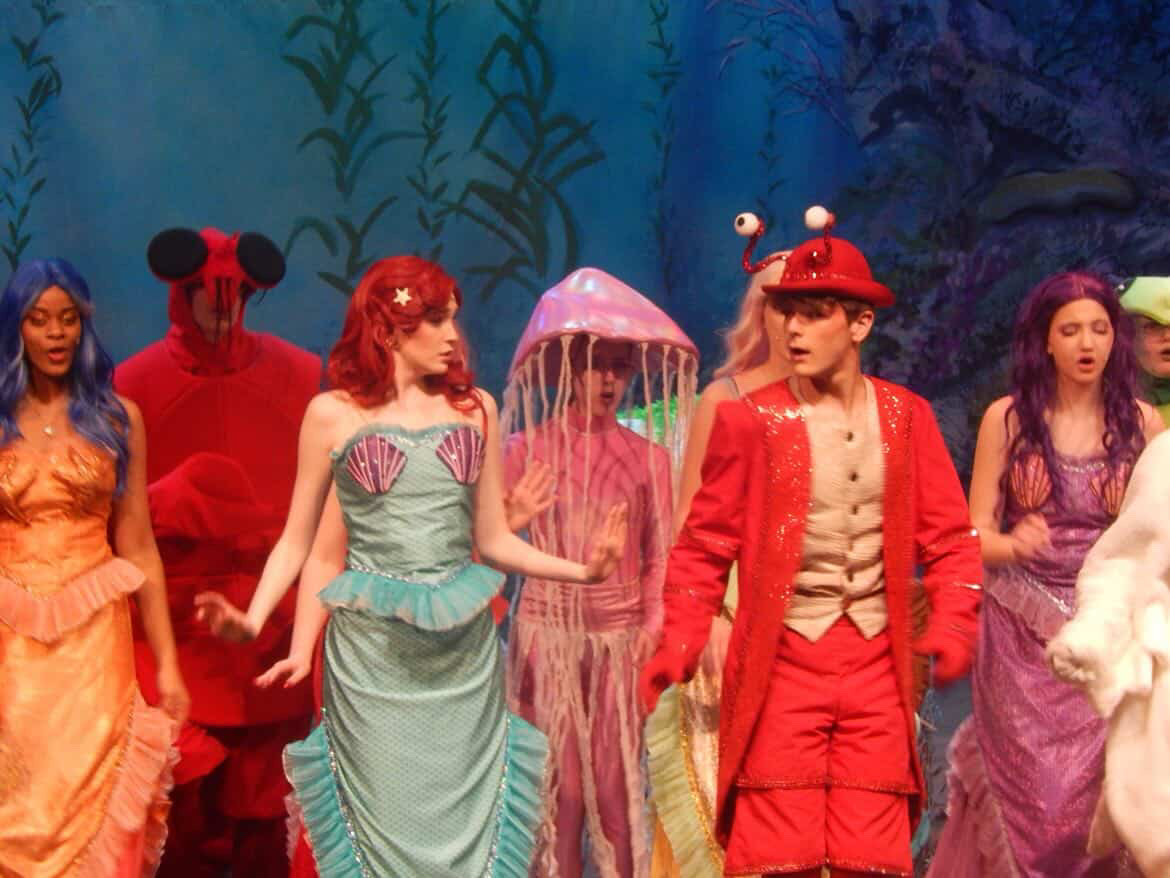
From the third row, it looks like magic. The lights shift, the backdrop falls, and suddenly you’re underwater. Ariel sings every note of Part of Your World perfectly, and Sebastian’s comedic timing is impeccable. Behind the curtain, audiences don’t see the stage manager in the nest above, calling cues into their headset, the student musicians tucked into the pit, or the dozens of rehearsals students have had since January, squeezing three-hour sessions between homework, jobs, and everything else that comes with being a teenager.
FHS’s spring production of The Little Mermaid is one of the school’s biggest musicals in recent history. Pulling it off takes a cast, a crew, a pit orchestra, talented directors, and even some help from parents.
Directors Dean and Sue Cobb, volunteers who have been guiding FHS theater for several years, chose The Little Mermaid for a specific set of reasons.
“We originally had three shows we were choosing from,” Sue Cobb explained. The Little Mermaid best suited the talent pool they knew they had, called for a large orchestra, and was family-friendly. The decision came in December, late by their standard, and from that point on, the clock was ticking.
The creative challenge at the heart of the show is making an audience believe they’re under the sea without a single drop of water.
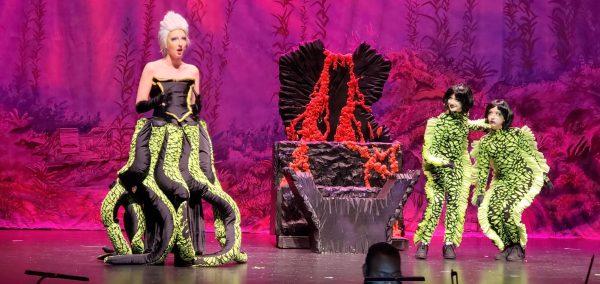
“Trying to help the audience suspend disbelief when watching sea creatures and being true to a Disney-esque look becomes the challenge,” Sue Cobb said. “We needed to create an underwater home that has humans, sea creatures and birds, and make it somewhat believable for adults, teens and children.”
Their solution involves lights, drops, creative set pieces, and — in a nod to one of the show’s own songs — what she calls “Positoovity.”
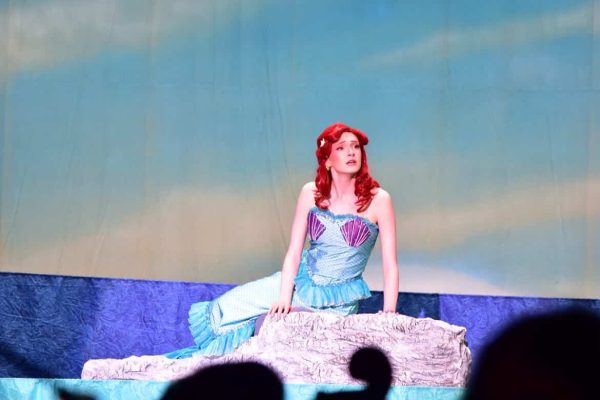
Senior Olivia Campbell, who plays Ariel, feels the scale of the show has changed. Having appeared in three FHS productions before this one — as Gladys in The Pajama Game, Rizzo in Grease, and Winifred in Once Upon A Mattress — she has a frame of reference.
“I think we’ve gone up since my freshman year,” Campbell said. “It’s a big show. There’s a lot of tech that goes into it.”
Most people don’t consider where set pieces really come from, who measured, cut and painted it, or the fact that the staircase they’re watching characters climb has probably appeared in two or three previous shows.
“We have cut up pieces from different shows to use for other ones,” senior Madi Sicilia said, the production’s stage manager.
Sicilia, who has been involved with stage crew since her freshman year, has watched the set-building process up close for eight shows. The labor comes largely from parents, and from the Cobbs, who fund set pieces themselves.
“All of the set pieces come out of pocket,” Sicilia said. A dedicated team of theater parents, many of them with carpentry backgrounds, gather on weekends and free time for about two months to build out whatever the directors have envisioned.
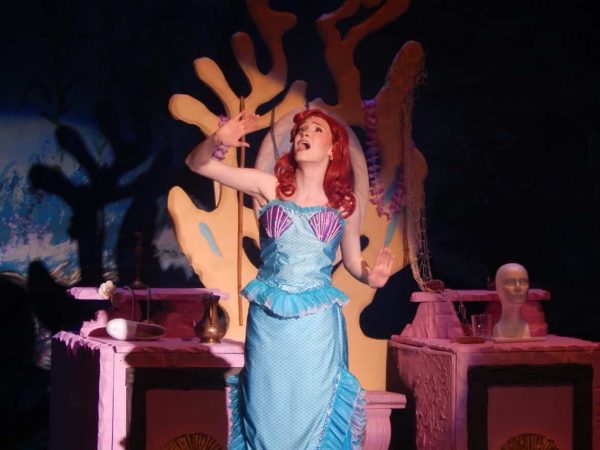
This year’s fall play, Arsenic and Old Lace, had zero set pieces, while The Little Mermaid has 17 individual set pieces in motion throughout the show.
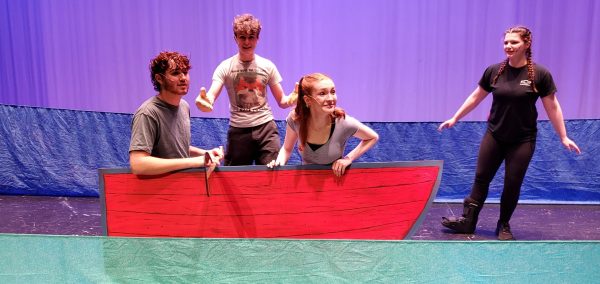
“We have two giant set pieces of a boat just taking up room on each side of the stage,” Sicilia said. Add to that waves, plants, a small romantic rowboat for Kiss the Girl, and three different backdrop drops on overhead tracks.
“The crew is going from zero to seventeen,” Sicilia said. “My heart goes out to everyone.”
Beyond the physical demands of set work, Sicilia emphasized how much behind-the-scenes roles matter to a production’s success.
“Sound is the unsung hero of theater,” Sicilia said. “Without sound, the whole show is ruined.” Sicilia recounted times audience members have approached sound operators after a show to compliment them, not on the sound but on the lights.
“And the sound person, kind of defeated, just goes, ‘Oh. Thanks.’”
The crew for The Little Mermaid is around 17 to 18 people, organized into four main branches: backstage runners who manage set pieces and props; hair and makeup; lights; and sound. Lights and sound share the tech booth; backstage crew work in the wings. Sicilia, in her new role as stage manager, operates from an elevated position called “the nest,” calling cues over a headset that connects the entire operation. It’s the first musical where she won’t be backstage herself.
“It makes me a little bit nervous,” Sicilia said. “But I do enjoy being in charge.”
The theater department faces a challenge that never changes: limited stage time. There is no theater class at FHS — unlike choir or band, which have dedicated periods built into the school day. The Cobbs are volunteers, and stage time has to be reserved around every other school event that needs the auditorium.
Between 80 and 90 students are involved in this production. Preparation starts in January — three to four rehearsals a week, two hours apiece, ramping to afternoon and evening sessions in the final stretch. The week before opening involves a double run-through on Friday, full dress rehearsals on Monday and Tuesday, and then three performances: Thursday, Friday, and Saturday.
This is Campbell’s fourth and final spring musical. While getting ready to play Ariel she is also on a dance team, waiting on college decisions, working at Panera, and keeping up with schoolwork. Campbell has loved Ariel since she was young, having fond memories of singing along to The Little Mermaid’s soundtrack on her mom’s bedroom radio.
“Obviously, this is stressful,” Campbell said. “But everything is worth it. Our rehearsals are a lot of fun. Our show is gonna be good, and I know it always comes together at the end.”
In early conversations with Dean Cobb, Campbell said they identified two distinct ways to play Ariel: as a perfect Disney princess or like a teenage girl with real feelings.
“I kind of want to find a mix,” Campbell said. “I want to appeal to the little kids, because that’s what I would have wanted as a kid. But I also want to have a little bit of myself.”
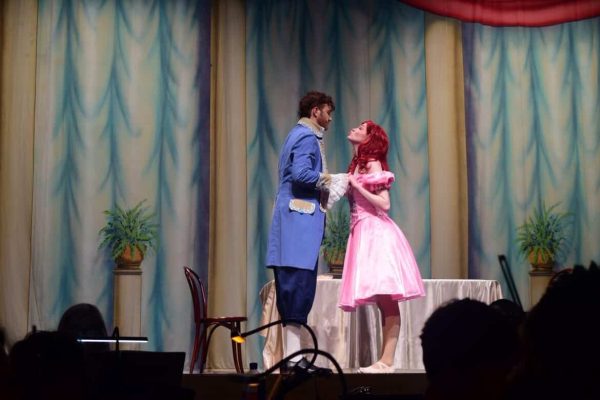
Prince Eric, Ariel’s love interest, is played by Drew Shenton, a senior from Novi Christian High School, whose own school had no spring musical this year. Campbell works with Shenton and recruited him, thinking he would be perfect for the role.
Dean Cobb has been involved with theater since 1970, and Sue since 1986. They aren’t getting paid, they don’t have a class period, and they don’t even have a guaranteed audience. They simply do this out of passion.
“The Cobbs are volunteers,” Sicilia said. “They’re doing this purely for the love of the game.”
When asked what she’s most proud of, Sue Cobb answered, “It’s always the students. They have to work very hard to achieve success in any show.”
Campbell is just as dedicated to theater, coming back to what she loves about performing — not the spotlight necessarily, but the collaboration.
“I like helping someone’s vision,” she said, “and making it come alive.”
The musical was a success, elevated by thoughtful touches that made the experience even more memorable than in years past. After each performance, characters stayed to meet audience members and sign autographs, creating a special connection with attendees. During intermission, Sebastian (Brody Kennedy), Scuttle (Katie Martinchick), Flotsam (Kelsey Hill), and Jetsam (Cece Cardone) delighted the crowd by staying in character while hosting nightly raffles and giving away prizes. In every moment, the students’ dedication, creativity, and teamwork shone through, culminating in a heartfelt production that left a lasting impression on everyone who attended.