










Too successful and you’re a threat. Too human and you’re a disappointment. For women in pop, there is no version of winning without condition. Pop music is arguably in one of its most exciting eras in years, but somehow the loudest conversation isn’t about the music.
Women are leading this era, selling out stadiums, breaking streaming records and headlining festivals, and somehow instead of being met with praise, they are given lists of complaints. Too bold. Too boring. Not humble enough. The critiques are endless. Women in pop aren’t just held to a higher standard, they’re held to an impossible one.
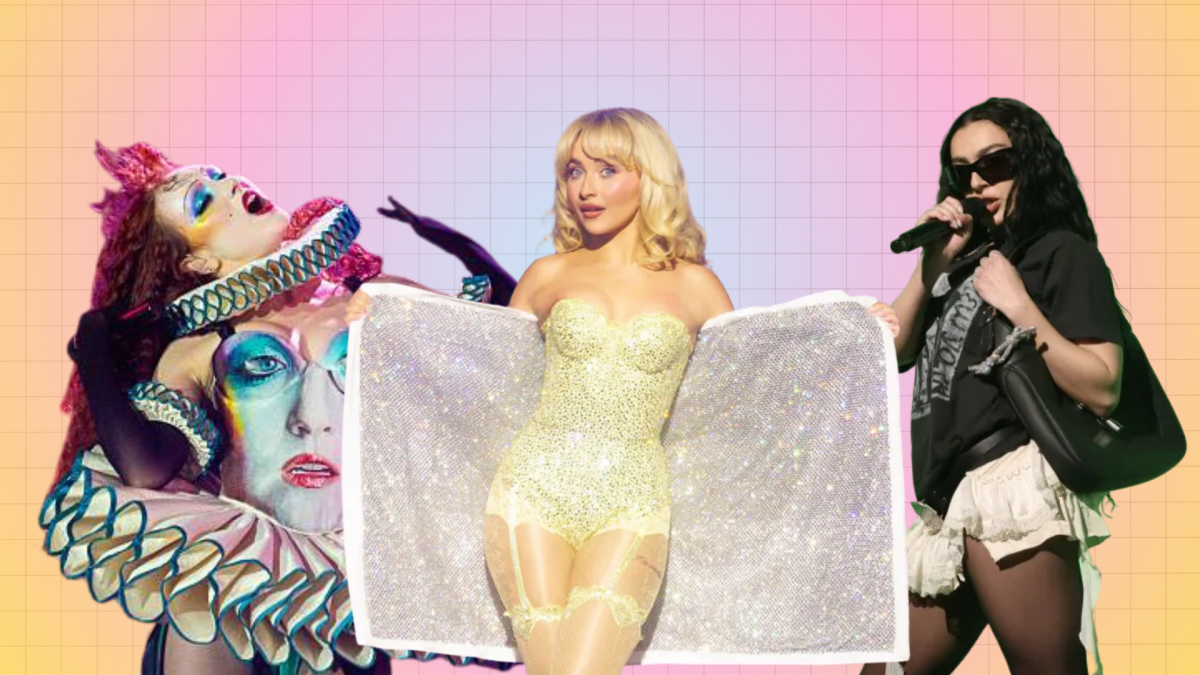
No case makes this clearer than what happened to Chappell Roan in March. At Lollapalooza in São Paulo, an 11-year-old fan staying at the same hotel as Roan walked past the singer’s table at breakfast, confirmed it was her, smiled, and returned to sit with her mom. The 11-year-old happened to be the daughter of famous footballer, Jorginho. The events that followed, according to an aggressive Instagram post from Jorginho, were completely disproportionate with reality. Jorginho claimed a security guard, sent by Roan, approached the young girl, spoke aggressively and left the child in tears. The internet exploded with massive hate towards Roan.
The following day, Roan posted an apology video saying she had no idea anyone had approached the child’s table, and that she hadn’t even noticed them. Weeks later, the full picture emerged. The security guard came forward and confirmed the actions were not taken on behalf of Roan, her personal security team, or her management. Jorginho himself returned to Instagram to say it had all been a misunderstanding and that Roan was innocent. The story was over — except it wasn’t, because by then, most people had already moved on with their verdict intact.
This wasn’t even an isolated moment. Roan has gone viral several times for her bold confrontation when it comes to the paparazzi. During one instance, Roan turned the camera back to the photographers after being followed and harassed, and asked them to leave her alone. It was of course treated as a meltdown, a diva moment, proof of an attitude problem. But when Justin Bieber’s “I’m a dad” confrontation with paparazzi circulated, fans empathized with him and called him “human.” When Tyler the Creator has gone off on photographers, it gets clipped and reposted as unbothered and relatable. The response couldn’t be more different. For men, pushing back against invasive media is brave. For Chappell Roan, it’s a character flaw.
This spring, Justin Bieber headlined Coachella on a stage with zero decoration other than his laptop. Bieber spent 25 minutes of his set on YouTube, scrolling through old videos in a hoodie and shorts. It was called raw, vulnerable, and a defiant artistic statement. The press ate it up. Meanwhile, Sabrina Carpenter also headlined this year, delivering a completely different kind of spectacle. Her set was a meticulously produced, narrative-driven show — elaborate staging, stunning custom Dior costumes, and crazy crowd engagement. It was a landmark performance, not only in Carpenter’s career but in Coachella history.
The response? Rather than simply celebrating what was an undeniable moment, the internet immediately dragged Beyonce into the conversation. Suddenly, it wasn’t about what Carpenter accomplished — it was about whether she measured up to Beyonce’s legendary 2018 Coachella set, widely considered one of the greatest live performances of all time. Two completely different eras, two completely different visions — forced into a competition that only existed because people want a winner and a loser. Bieber got a laptop and a revelation. Carpenter put on an amazing show, and was only met with negativity. The double standard continues to write itself.
Pitting female stars against each other is nothing new. The pressure doesn’t just come from fans, but seeps deep from the industry itself. Singers Charli XCX and Lorde create similar genres of music, and have spent years pitted against each other because the industry seemed to not have enough space to hold both at once. The constant comparison got to the point where Charli admitted she felt genuine jealousy and resentment toward Lorde’s success, even though nothing had personally happened between the two. Charli invited Lorde to remix her song “Girl, So Confusing” that turned their manufactured rivalry into understanding. They chose to name their feud with the system, instead of each other.
On “You Need to Calm Down,” Taylor Swift called out exactly this, writing “And we see you over there on the internet / Comparing all the girls who are killing it” and I could not agree more, but comparison is just one symptom of a much larger problem. Women in the music industry are not allowed to just exist. Everything is a scandal. Every success needs a qualifier. Every indication of being human is a flaw. Though the music is extraordinary, the criticism is exhausting, and until we start scrutinizing the double standard as hard as we scrutinize these women, nothing changes.